

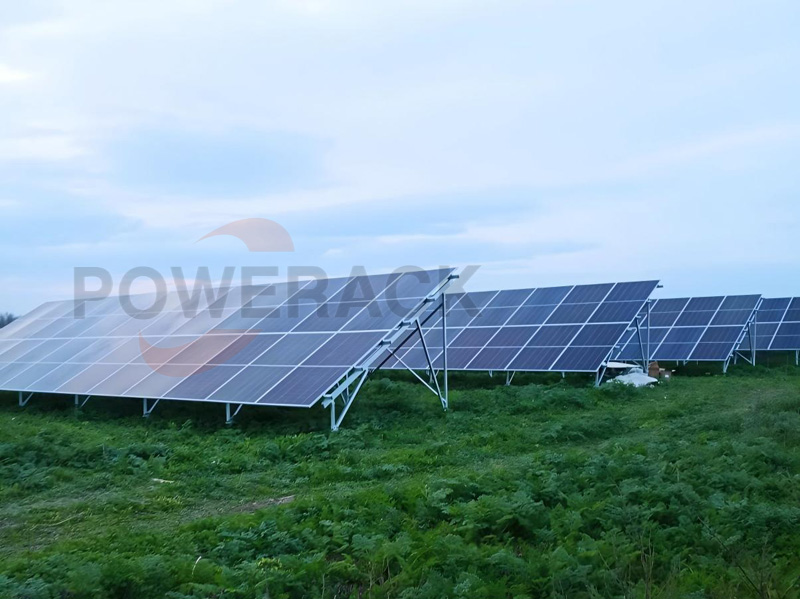
Many solar projects fail to generate as much electricity as expected. After ruling out module and inverter malfunctions, the problem often lies in the design of the mounting structure spacing. Localized shading not only reduces power generation but also causes hot-spot effects, which accelerate module degradation and shorten the overall service life of the power plant. Mounting structure spacing is a critical factor in balancing installed capacity and power generation revenue.
If the spacing is too narrow, the low angle of the sun in winter will cause the front-row supports to cast shadows onto the surfaces of the rear-row modules. Since photovoltaic modules operate in series, if even a single module is partially shaded, it will reduce the output power of the entire string, resulting in power generation losses of up to 20% or more. Blindly pursuing the installation of more modules and reducing row spacing may increase installed capacity in the short term, but it will lead to sustained power generation losses in the long term, making it a case where the costs outweigh the benefits. Industry-standard design guidelines use the condition of no mutual shading at 9:15 a.m. true solar time on the winter solstice as the design benchmark. Since the sun’s altitude is lowest and shadows are longest on the winter solstice, ensuring no shading during this time guarantees adequate sunlight conditions during the year’s primary power generation periods.
The minimum spacing between mounting racks is influenced by three key factors: project latitude, module tilt angle, and mounting height. The higher the latitude, the lower the sun’s angle in winter, requiring a greater row spacing; the greater the tilt angle, the higher the vertical height of the module’s top, resulting in longer shadows cast, which in turn requires a larger spacing. For ground-mounted power plants and flat-roof PV systems, shadow simulation calculations are mandatory. On sloped roofs with color-coated steel tiles, where modules are arranged along the roof pitch, the risk of self-shading between rows is low; the primary focus is on avoiding external shadows cast by parapets, ventilation equipment, and surrounding buildings.
When designing, it is important to carefully weigh the trade-offs. Increasing the spacing can completely eliminate shading between rows, but it will occupy more space and reduce the number of modules that can be installed; decreasing the spacing can improve land utilization, but it comes with the trade-off of shading losses during winter. In actual projects, one cannot simply apply general empirical values; instead, simulation calculations must be performed based on site conditions to find the optimal balance between installed capacity and power generation efficiency. At the same time, design drawings must be strictly followed during the construction phase to prevent arbitrary reductions in mounting frame spacing on-site.
In addition to shading between rows, it is important to consider the shadows cast by surrounding obstacles. Trees, parapets, ventilation units, pipes, and other structures can all cast persistent shadows during the early morning and evening hours. When planning the layout, position the modules outside the shadowed areas of these obstacles while also reserving access space for future maintenance and cleaning, thereby balancing power generation performance with operational and maintenance convenience.
FAQ
Q1: Does a wider spacing between mounting racks result in higher power generation?
A: Not necessarily. If the spacing is too wide, the number of modules that can be installed on the site decreases, leading to a reduction in total installed capacity. The key to spacing design is ensuring there is no shading between rows during critical periods on the winter solstice. Increasing the spacing beyond a reasonable range will not significantly boost power generation; instead, it will reduce land or rooftop utilization.
Q2: Do rooftop PV systems also require calculations for mounting spacing?
A: On sloped roofs, modules are installed along the roofline, so the risk of self-shading between rows is minimal; generally, row spacing does not need to be calculated. For flat-roof PV systems, however, the steep angle of the mounting structure makes it easy for front and back rows to shade each other, so spacing calculations are essential. Additionally, external shadows cast by parapets and equipment must be avoided.
Q3: For an existing power plant where it is discovered that the mounting spacing is too narrow and shading is occurring, how should this be remedied?
A: First, use software to assess the annual shading loss. If the loss is minor, you can optimize inverter configuration and re-zone string groups to reduce hotspots and power loss; if the shading loss is severe, you must locally adjust the mounting layout, reduce the tilt angle, or remove some modules to resolve the shading issue at its root.
MOTS CLÉS :
Add : 606, No. 12, Huasheng Road, Huli District, Xiamen,China
WhatsApp : +86153 9592 2968
E-mail : info@powerack.com



 français


