

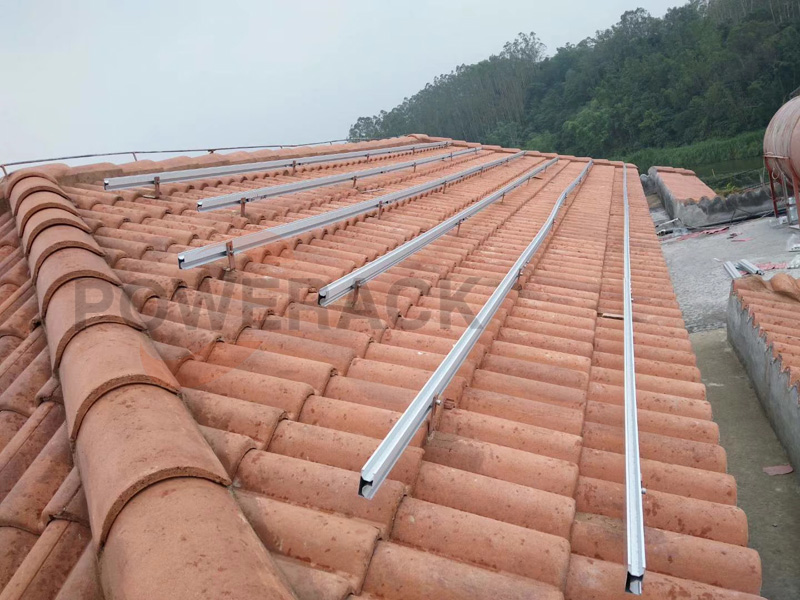
Dans un système de montage photovoltaïque complet, le rail constitue l'élément porteur principal et la structure intermédiaire essentielle reliant les modules photovoltaïques au cadre de montage principal. Si les défaillances observées dans la plupart des projets semblent provenir de problèmes liés aux modules, à l'étanchéité ou à la résistance au vent, elles sont souvent dues en réalité à des rails trop fins, insuffisamment rigides ou mal installés. Des rails photovoltaïques de haute qualité déterminent directement la planéité, la stabilité et la durée de vie opérationnelle de 25 ans du champ photovoltaïque ; ils constituent la base du fonctionnement sûr et durable des centrales photovoltaïques.
La fonction principale de rails de montage photovoltaïques L'objectif est de répartir les charges uniformément et de transférer les forces. Le poids des modules photovoltaïques, les charges dues au vent et à la neige, ainsi que l'effet de succion du vent en altitude n'agissent pas directement et de manière concentrique sur les poteaux de fixation et les bases de toiture ; ce sont les rails qui supportent la totalité de la charge et la répartissent uniformément sur la structure de fixation principale et la structure porteuse du bâtiment. Des rails haute résistance d'épaisseur standard empêchent les surcharges localisées, évitant ainsi la flexion des supports et la fissuration localisée de la toiture sous l'effet de la pression. À l'inverse, l'absence de rails ou l'utilisation de rails non standard à parois minces entraîne une répartition inégale de la charge. En cas de vents violents ou de fortes chutes de neige, cela peut facilement provoquer une déformation des panneaux, un desserrement des supports et des contraintes anormales sur les modules, réduisant considérablement le coefficient de sécurité de la centrale.
Les rails de montage remplissent une double fonction : niveler la surface des panneaux et les protéger du vent. Les toitures et les poteaux de support présentant inévitablement des variations de hauteur, les rails de guidage permettent de standardiser et d'uniformiser la base d'installation, assurant ainsi un support et une répartition de la charge uniformes aux modules photovoltaïques. Ceci élimine les situations où les modules sont partiellement suspendus ou soutenus en un seul point, prévenant ainsi des problèmes courants tels que les fissures cachées dans les cellules solaires, la déformation du verre et les dommages au cadre dus à la compression à la source, et réduisant les défaillances par points chauds et la dégradation de la puissance. De plus, associés à des pinces, les rails de guidage relient les modules individuels en un ensemble cohérent, limitant efficacement les vibrations à haute fréquence lors de vents violents et dispersant les forces de traction induites par le vent. Ceci améliore considérablement la résistance au vent et aux séismes de l'ensemble du système, le rendant adapté à des conditions d'exploitation difficiles telles que les typhons côtiers et les vents violents en plein champ.
Les avantages des rails de montage standardisés sont particulièrement manifestes lors de la construction sur site, ainsi que lors des opérations d'exploitation et de maintenance ultérieures. Profilés modulaires universels, ces rails offrent une grande marge de réglage, permettant d'accueillir les modules aux dimensions les plus courantes disponibles sur le marché. Ils corrigent avec souplesse les écarts d'installation dus à l'espacement des colonnes et aux irrégularités de la toiture, améliorant ainsi considérablement la précision de la construction et l'efficacité de l'installation. Correctement installés, les rails rehaussent uniformément la hauteur libre des modules, garantissant un espace de ventilation standard à leur base. Ceci favorise le refroidissement par convection et un drainage rapide, stabilise le rendement de production d'énergie et ralentit le vieillissement des modules. Parallèlement, ils permettent un agencement soigné des câbles photovoltaïques, prévenant leur usure et leur affaissement, et répondant aux normes d'exploitation et de maintenance ainsi qu'aux normes de sécurité incendie, pour une centrale électrique propre et ordonnée. À l'inverse, les rails de qualité inférieure, à parois fines et peu résistants à la corrosion, sont très sensibles à la rouille, à la déformation et au desserrage des fixations, ce qui en fait une cause majeure de dysfonctionnements fréquents dans les centrales photovoltaïques durant leur durée de vie.
Bien que les rails de montage soient considérés comme des éléments auxiliaires des systèmes de montage, ils déterminent la qualité globale et la durée de vie d'une centrale solaire. rails de montage solaire Fabriqués à partir de profilés haute résistance et de tolérance zéro conformes aux normes nationales, nos produits, conçus selon des calculs mécaniques précis, offrent une capacité de charge élevée et une rigidité optimale. Grâce à un traitement de galvanisation à chaud renforcé ou à un alliage d'aluminium haut de gamme anticorrosion, ils résistent aux sels minéraux, aux alcalis et aux UV, garantissant ainsi 25 ans de fonctionnement continu en extérieur. Compatibles avec de nombreux systèmes de montage, nos produits s'adaptent à toutes les installations, des toitures plates aux toitures en tuiles, en passant par les centrales au sol. Ils répartissent uniformément les charges sur la toiture, préservent l'intégrité structurelle des modules et améliorent la résistance au vent de l'installation. En prenant en compte les risques techniques potentiels dans les moindres détails, ils assurent un fonctionnement sûr, stable et performant des centrales photovoltaïques.
Add : 606, No. 12, Huasheng Road, Huli District, Xiamen,China
WhatsApp : +86153 9592 2968
E-mail : info@powerack.com



 français


